Bravqeli
Axis Pack
Axis Pack
Couldn't load pickup availability
1. Problem Statement
After the first introduction to game development, a new question often appears: how do you move from a separate idea to a complete learning scene? A learner may already understand that a game includes a character, objects, rules, and actions, but may not yet see how these parts hold together. Because of that, a learning idea can feel scattered: the character moves separately, the scene exists separately, and the task does not have a clear logic. Another challenge appears when the learner does not know which part should be described first: space, action, condition, goal, or object. Without a basic axis, a learning example can lose order, even when the idea itself is interesting.
2. Solution
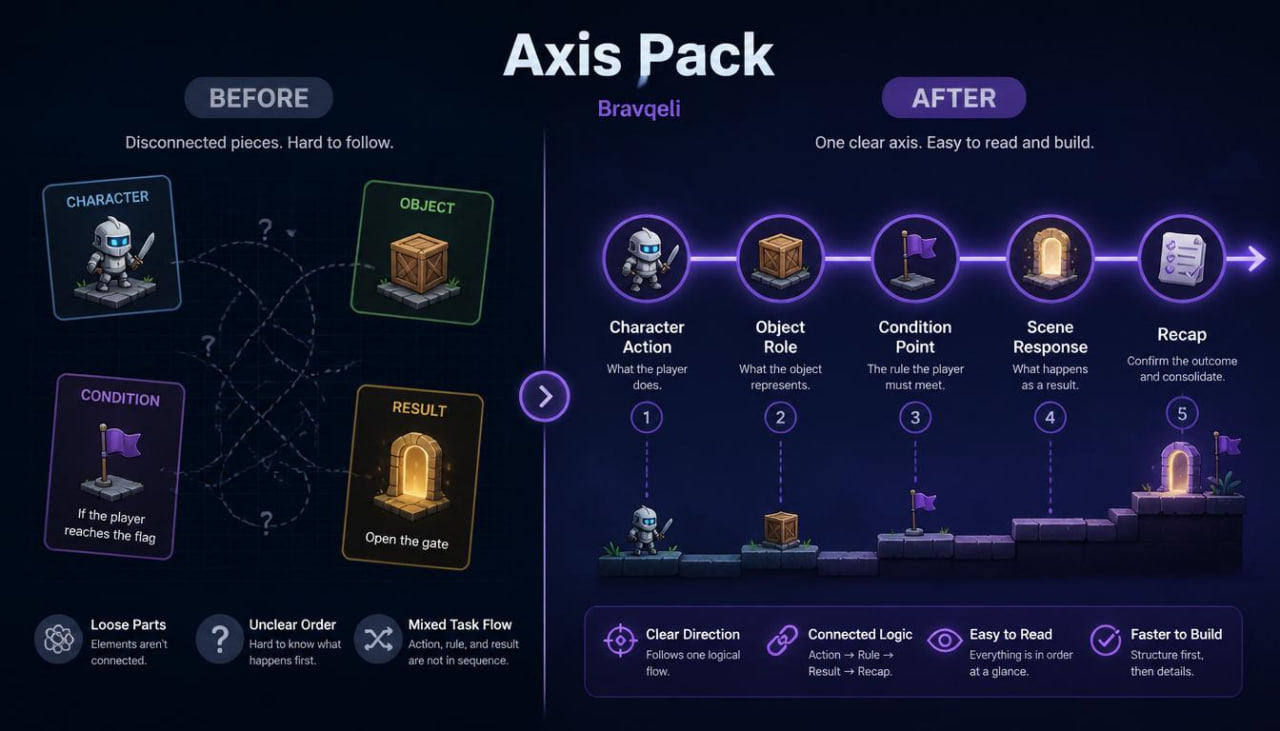
Axis Pack helps build the central line of a learning game scene. The materials show how to begin not with a large concept, but with one main connection: the character performs an action, the scene responds, the rule checks a condition, and the learner sees the result. This approach helps explain why each element in the scene has its own place. The tier explains how to describe a game not chaotically, but through the sequence “action — condition — change — recap.” With this structure, the learner can move from a first introduction to more organized work with learning examples.
3. What’s Inside
Axis Pack includes a set of materials that divide a learning scene into its main parts. The first module focuses on the idea of the game axis. It explains that each small scene has a central direction: from the character’s action to a change in the space. For example, the character touches an object, presses an element, moves into a new area, collects an item, or changes the state of the scene. The learner studies not only the action itself, but also what this action starts.
The second module explores scene structure. It explains how to define the boundaries of the space, the main focus point, objects for interaction, and a basic goal. The materials show how to avoid overloading the scene with too many details at an early stage. Instead, the learner works with a small scheme: where the character starts, where movement can happen, what can change, and which action matters inside the example.
The third module focuses on the connection between the character and objects. It explains how an object can be more than a background element; it can be an active part of the learning scene. An object can stop movement, change state, open a new path inside the example, start a hint, or mark the end of a task. The learner receives practical schemes where they describe what the object does and how the character interacts with it.
The fourth module is centered on conditions. In game development, a condition helps define when a certain event should happen. In Axis Pack, this is explained through simple learning situations: if the character reaches an area, if an item is collected, if an obstacle is avoided, if an action is completed, then the scene changes. The learner sees how a condition makes scene behavior more organized.
The fifth module contains practice tasks. These exercises ask the learner to describe a mini scene, define the main action, add one object, write a condition, and explain the result. The tasks are built so the learner does not only read the materials, but works with small game situations. This helps connect explanation with practice.
The sixth block includes planning tables. In these tables, the learner can write the scene name, character role, main action, object, condition, change, and short recap. This format helps keep details in order and makes the scene logic visible on one page.
The tier also includes a review block. It contains short self-check questions: what is the main action, which condition starts the change, which object participates in the scene, what happens after interaction, and whether the example has a complete structure. This block is useful when returning to the material after completing the exercises.
Axis Pack differs from Free Kit because it does not only introduce basic ideas; it helps assemble the first structured learning scene. This tier is for learners who want to take the next step after the introductory set and begin thinking about a game idea as a sequence of connected parts.
4. Who Is This For?
Axis Pack is for learners who have already reviewed introductory materials or have a minimal understanding of game development topics. It is useful for those who want to move from general interest to a more organized study process.
This tier also fits people who have several game ideas but do not yet know how to choose the main action and build a scene around it. If there is a character, a space, or a task in the learner’s mind, but those parts are not connected yet, Axis Pack helps form a logical bridge between them.
The materials can also work well for learners who like tables, short schemes, and practice exercises. There is no need to create a large project at once. The learner works with small examples where each part has a readable role.
5. What You’ll Learn
- How to define the main axis of a learning game scene.
- How to connect a character, action, object, and condition.
- How to describe a scene without overloading it.
- How to choose the main action for a mini example.
- How to write a condition for a scene change.
- How to explain the result of character-object interaction.
- How to create a short table for scene logic.
- How to divide a learning idea into sequential parts.
- How to check whether a scene has a complete structure.
- How to prepare a base for wider topics in the next tiers.
6. 30-Day Return Terms
Axis Pack includes a 30-day payment return option according to the Bravqeli store terms. If, after reviewing the materials, the buyer sees that the format, level, or structure of the tier does not fit their needs, they can contact the support team within 30 days. The request is reviewed according to the store rules and the order details. This approach allows the buyer to review the materials calmly and make a decision without pressure.
Self-paced learning overview
- 🧾 Digital file available after purchase
- 🕒 Long-term availability
- 🔐 Secure checkout
- 🗓️ Content updated in 2026
What is included in Bravqeli learning materials?
What is included in Bravqeli learning materials?
Each tier includes structured game development materials: explanations, examples, practice tasks, short recaps, and review exercises. The amount of content depends on the tier, but the learning flow stays similar: each topic is divided into parts so the learner can study ideas, rules, and basic approaches gradually.
Do I need previous preparation?
Do I need previous preparation?
For the starting tiers, previous preparation is not required. The materials are built so the learner can begin with basic ideas: game scene, character, action, condition, interaction, task, and the structure of game logic.
What format are the materials in?
What format are the materials in?
The materials are provided in a digital format for self-paced study. They may include modules, written explanations, diagrams, task examples, practice exercises, checklists, and short review blocks.
Share