Bravqeli
Cipher Module
Cipher Module
Couldn't load pickup availability
1. Problem Statement
When a learning scene already has space, areas, routes, objects, events, and transitions, the learner may face a new challenge: how to write the inner rules correctly. Sometimes a scene looks readable visually, but its behavior remains unclear: it is unknown which condition starts an action, which object reacts first, and what changes after interaction. Because of this, the learning example can be difficult to explain, review, or adjust. The learner may also find it hard to separate the main rule from supporting rules, especially when the scene includes several objects and several states. Without a readable rule system, the scene can look gathered but still behave like a set of unrelated reactions.
2. Solution
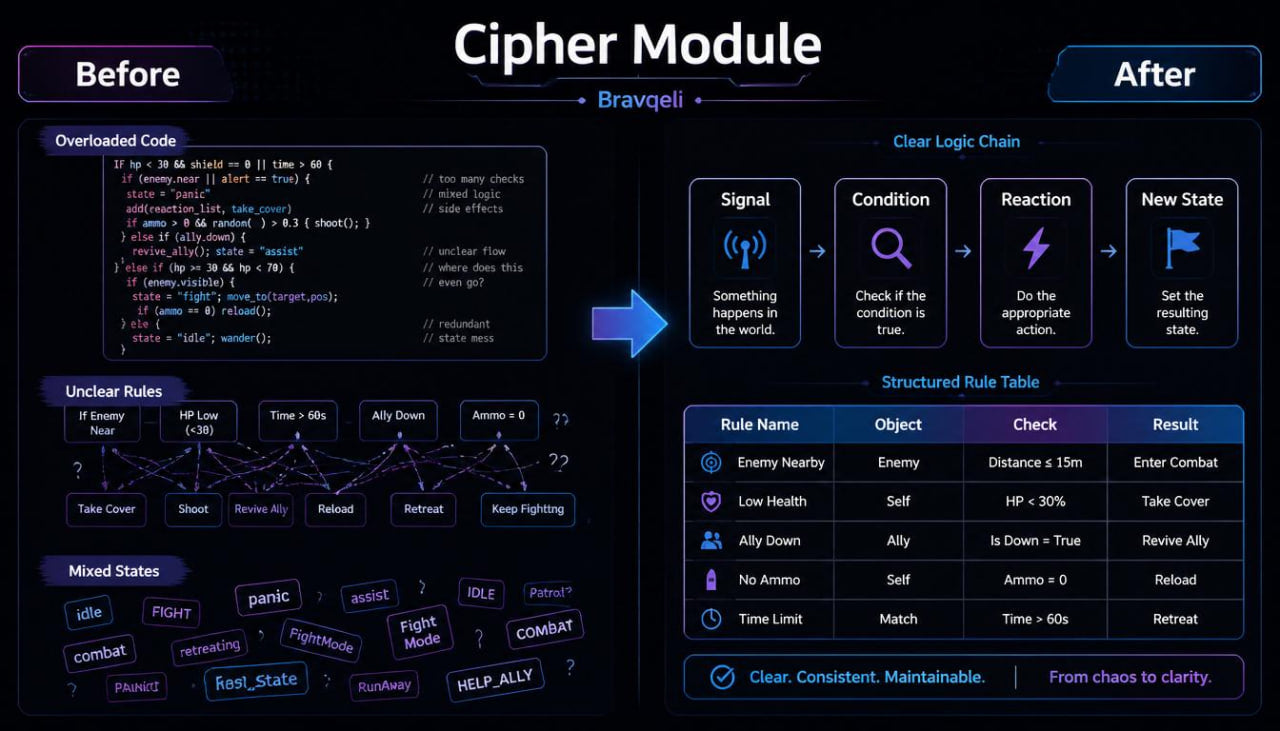
Cipher Module helps the learner read a scene as a system of conditions, signals, and reactions. The materials show how to write rules in the format: “if an action happened — check a condition — change a state — show the result.” The learner works with examples where each rule has a name, place, object, condition, reaction, and recap. This approach helps show which parts of the scene guide behavior and which parts support the example. Cipher Module fits learners who can already build scenes and want to move into a more exact description of inner logic.
3. What’s Inside
Cipher Module includes materials that explain scene rules through condition links, signals, states, and reactions. If the previous tier worked with the space grid and areas, this tier focuses on what happens inside that grid: which rules work, when they start, how they change the scene, and how they can be written for later review.
The first module focuses on the idea of a rule. The learner studies a rule as a short behavior description: what should happen, under which condition, with which object, and which state follows. For example, if the character enters a certain area, the scene may check for a needed state; if the state matches the condition, an object changes appearance or opens a new route inside the learning example. The materials explain how to avoid mixing several rules into one heavy block.
The second module explains condition signals. In a scene, a signal can be contact with an object, position change, action completion, entry into an area, state change, or completion of a short cycle. The learner studies how to define which signal starts the next check. This helps separate the character’s action from the scene’s reaction.
The third module focuses on writing conditions. A condition should answer the question: what exactly is checked before a change. For example, whether the character is in the needed area, whether an object state has changed, whether a previous action has been completed, or whether a part of the route has been finished. The materials include tables where the learner can write a condition briefly: “object active,” “character in area,” “action completed,” “route open inside the example.”
The fourth module explores reactions. After the condition is checked, the scene should answer with a change. This can be a new object state, route change, cue appearing, action closing, transition to another scene part, or task update. The materials explain that the reaction should be connected with the rule and should not appear at random.
The fifth module focuses on states. The learner studies how to write states in a short and readable way: “character moving,” “object changed,” “area open inside the example,” “task finished,” “obstacle removed.” These notes help show the position of the scene after each action.
The sixth module explains rule chains. Sometimes one rule starts the second rule, and the second leads to a third. For example, the character changes an object state, after that the scene allows a new route, and then another area checks the updated state. In Cipher Module, these chains are shown through short schemes so the learner can see the order and not lose the reason for each change.
The seventh module focuses on symbols and marks. The learner receives a neutral mark system for personal notes: action, condition, reaction, state, transition, repetition, check. These marks help read a personal scheme with less effort, but they do not replace explanations. Each symbol should have a short description, so the learning example stays readable after review.
The eighth module explores rule logic errors. The materials show examples where a condition exists but a reaction is missing; where a reaction appears without a readable signal; where two rules conflict; where a state changes but is not written down; or where one action starts too many changes. The learner studies how to find these places and edit them.
The ninth block contains practice exercises. The learner creates a rule set for a mini scene: main action, signal, condition, reaction, new state, and recap. Other exercises suggest taking a scene from previous tiers and rewriting it through rules. There are also tasks where the learner needs to find an extra rule, unclear condition, or reaction without a cause.
The tenth block includes planning tables. The learner can write the rule name, scene, object, signal, condition, reaction, new state, linked rule, and short comment. This table helps show how one part of logic connects with another.
A separate block is dedicated to review. It includes self-check questions: does the rule have a readable signal, is the condition written briefly, does the reaction match the action, is the state updated, do the rules avoid conflict, and can the chain of changes be explained in plain words. This block helps the learner review personal materials and make scene logic cleaner.
4. Who Is This For?
Cipher Module is for learners who have already worked with scenes, areas, routes, choices, and visual cues, but want to write inner rules with greater care. If previous tiers helped build space and connections, this tier helps describe scene behavior.
It is useful for learners who want to understand why a scene reacts in one way and not another. The materials fit learners who want to work with conditions, states, rule chains, and logic tables.
Cipher Module also fits learners who like order in details. The attention here is not on the scene’s visual appearance, but on its inner behavior: signal, check, reaction, state, and next step.
5. What You’ll Learn
- How to write behavior rules for a learning scene.
- How to define the signal that starts a check.
- How to phrase a condition briefly and clearly.
- How to connect a scene reaction with a character action.
- How to write states for a character, object, or area.
- How to build a rule chain without extra complexity.
- How to use marks for personal schemes.
- How to find conflicts between rules.
- How to create a “signal — condition — reaction — state” table.
- How to prepare inner logic for a wider learning example.
6. 30-Day Return Terms
Cipher Module includes a 30-day period for payment return requests according to the Bravqeli store rules. If, after reviewing the materials, the buyer sees that the format, level, or structure of the tier does not fit their needs, they can write to the support team within 30 days. The request is reviewed according to the store terms and order details. This format allows the buyer to review the materials calmly and choose a further learning route without pressure.
Self-paced learning overview
- 🧾 Digital file available after purchase
- 🕒 Long-term availability
- 🔐 Secure checkout
- 🗓️ Content updated in 2026
What is included in Bravqeli learning materials?
What is included in Bravqeli learning materials?
Each tier includes structured game development materials: explanations, examples, practice tasks, short recaps, and review exercises. The amount of content depends on the tier, but the learning flow stays similar: each topic is divided into parts so the learner can study ideas, rules, and basic approaches gradually.
Do I need previous preparation?
Do I need previous preparation?
For the starting tiers, previous preparation is not required. The materials are built so the learner can begin with basic ideas: game scene, character, action, condition, interaction, task, and the structure of game logic.
What format are the materials in?
What format are the materials in?
The materials are provided in a digital format for self-paced study. They may include modules, written explanations, diagrams, task examples, practice exercises, checklists, and short review blocks.
Share