Bravqeli
Frame Course
Frame Course
Couldn't load pickup availability
1. Problem Statement
When a learner already understands events, reactions, and short cycles, a new challenge appears: how to arrange all scene elements so they do not conflict with one another. A game idea may include a character, objects, conditions, and several actions, but without a clear frame it can feel overloaded. The learner may find it difficult to define where the scene starts, where the main focus point should be, which objects are needed, and which ones distract from the task. Another question is how to make the learning example readable for review: so it can be revisited, adjusted, and explained in plain words. Without a structural frame, a scene can have interesting parts but still lack a gathered form.
2. Solution
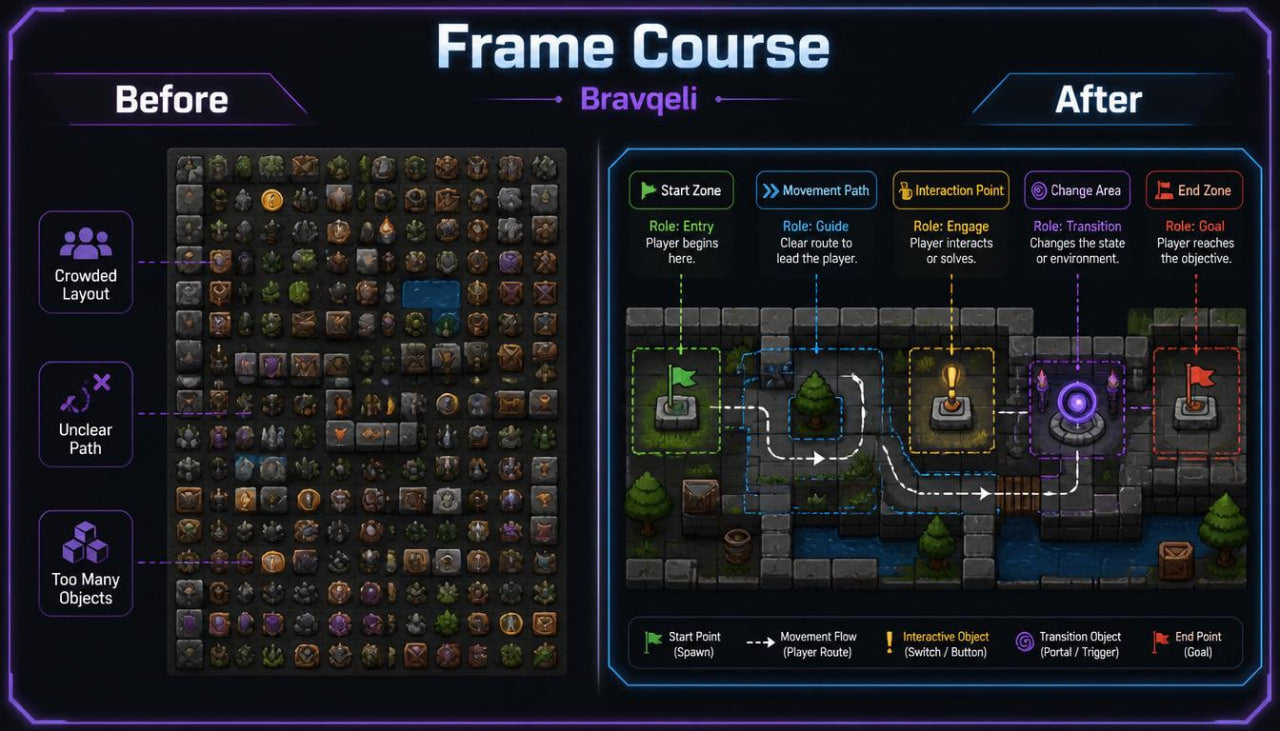
Frame Course helps the learner view a scene as a learning space with boundaries, roles, and sequence. The materials explain how to define the starting point, main action, supporting objects, change conditions, and final state of the example. The learner works not with a chaotic set of ideas, but with a scene shape where each element has its role. This approach helps with planning mini scenes, comparing variants, and seeing which parts can be shortened or clarified. Frame Course fits learners who want to move from separate events to a more gathered structure for learning game examples.
3. What’s Inside
Frame Course includes materials that help build a learning scene through shape and order. If the previous tier explained the rhythm of events, this tier helps show where those events are placed, how they connect with space, and how the scene stays inside one readable frame.
The first module focuses on scene boundaries. The learner studies how to define the beginning and end of a learning example. Boundaries may be spatial, logical, or story-based inside the exercise. For example, a scene can begin with the character appearing in a certain area and finish after interaction with an object. The materials explain why boundaries matter in study: they help avoid expanding the example without need and keep attention on the main action.
The second module explains element placement. The learner studies where the character can be, where the object is located, which area acts as an obstacle, and which part of the scene leads to task completion. The materials present this through simple schemes: start, path, object, condition, change, recap. This scheme helps the learner see the scene not only as a description, but as a map of interaction.
The third module focuses on the main focus point. In a learning scene, not every object has the same weight. Some elements form the background, some support movement, and one or two elements carry the main action. The learner studies how to ask: what is central in this scene, which action matters, which object starts the change, and what can be removed to make the example cleaner.
The fourth module is about object roles. The materials explain different role types in a learning scene: obstacle object, hint object, goal object, switch object, and marker object. The learner does not simply add items to the scene, but describes why they are there. This helps avoid a scene with many details but no readable direction.
The fifth module explores route building. A route in a learning example is not only character movement from one point to another. It is also the order of actions that should happen: see an object, move closer, perform an action, check the condition, receive a scene change, and move to the recap. In Frame Course, the learner works with route cards where each scene step is written down.
The sixth module explains learning transitions. A transition is the moment when the scene changes state or moves the learner to the next part of the example. It may happen after a completed condition, after contact with an object, after a short cycle ends, or after the character changes position. The materials help describe these transitions in plain phrases so the scene logic does not get lost.
The seventh block contains practice exercises. The learner receives tasks to build the frame of a mini scene: define the boundaries, starting point, main object, one obstacle, one condition, and final change. Other exercises suggest taking an overloaded scene and reducing it into a cleaner scheme. This develops attention to structure, not only to the idea itself.
The eighth block includes planning tables. The learner can write the scene name, boundaries, main action, character role, object list, role of each object, condition, change, and recap. This table helps show whether objects repeat the same role, whether there are too many events in one example, and whether the scene has a readable form.
A separate block is dedicated to review. It includes self-check questions: does the scene have a beginning and end, is the main action visible, is each object role clear, do extra details distract from the example, and can the scene be explained briefly. This block helps the learner return to the materials after exercises and adjust personal examples.
Frame Course focuses on the form of a learning scene. It does not add unnecessary complexity; it helps organize what the learner has already started to understand: character, action, event, condition, reaction, and state change.
4. Who Is This For?
Frame Course is for learners who already know the basic parts of a game scene and want to gather them into a more sequential example. It is useful for those who already understand events and reactions, but want to work better with space, boundaries, and object roles.
This tier also fits learners who often have many ideas for one scene and do not know what to keep or remove. The materials help view the scene through questions: where does it begin, where is the main action, what changes, what supports the example, and what only creates extra noise.
Frame Course can be suitable for learners who like schemes, maps, tables, and planning exercises. The focus here is not on a large concept, but on how to make a learning example gathered, readable, and useful for review.
5. What You’ll Learn
- How to define boundaries for a learning game scene.
- How to place a character, objects, and interaction areas.
- How to find the main focus point in a mini scene.
- How to describe the role of each object.
- How to build an action route for the character.
- How to create a “start — action — condition — change — recap” scheme.
- How to remove extra elements from a learning example.
- How to describe transitions between scene states.
- How to use a planning table for a scene.
- How to prepare gathered examples for broader topics in the following tiers.
6. 30-Day Return Terms
Frame Course includes a 30-day period for payment return requests according to the Bravqeli store rules. If, after reviewing the materials, the buyer sees that the format, level, or structure of the tier does not fit their needs, they can write to the support team within 30 days. The request is reviewed according to the store terms and order details. This format allows the buyer to review the materials calmly and choose a further learning route without pressure.
Self-paced learning overview
- 🧾 Digital file available after purchase
- 🕒 Long-term availability
- 🔐 Secure checkout
- 🗓️ Content updated in 2026
What is included in Bravqeli learning materials?
What is included in Bravqeli learning materials?
Each tier includes structured game development materials: explanations, examples, practice tasks, short recaps, and review exercises. The amount of content depends on the tier, but the learning flow stays similar: each topic is divided into parts so the learner can study ideas, rules, and basic approaches gradually.
Do I need previous preparation?
Do I need previous preparation?
For the starting tiers, previous preparation is not required. The materials are built so the learner can begin with basic ideas: game scene, character, action, condition, interaction, task, and the structure of game logic.
What format are the materials in?
What format are the materials in?
The materials are provided in a digital format for self-paced study. They may include modules, written explanations, diagrams, task examples, practice exercises, checklists, and short review blocks.
Share