Bravqeli
Free Kit
Free Kit
Couldn't load pickup availability
1. Problem Statement
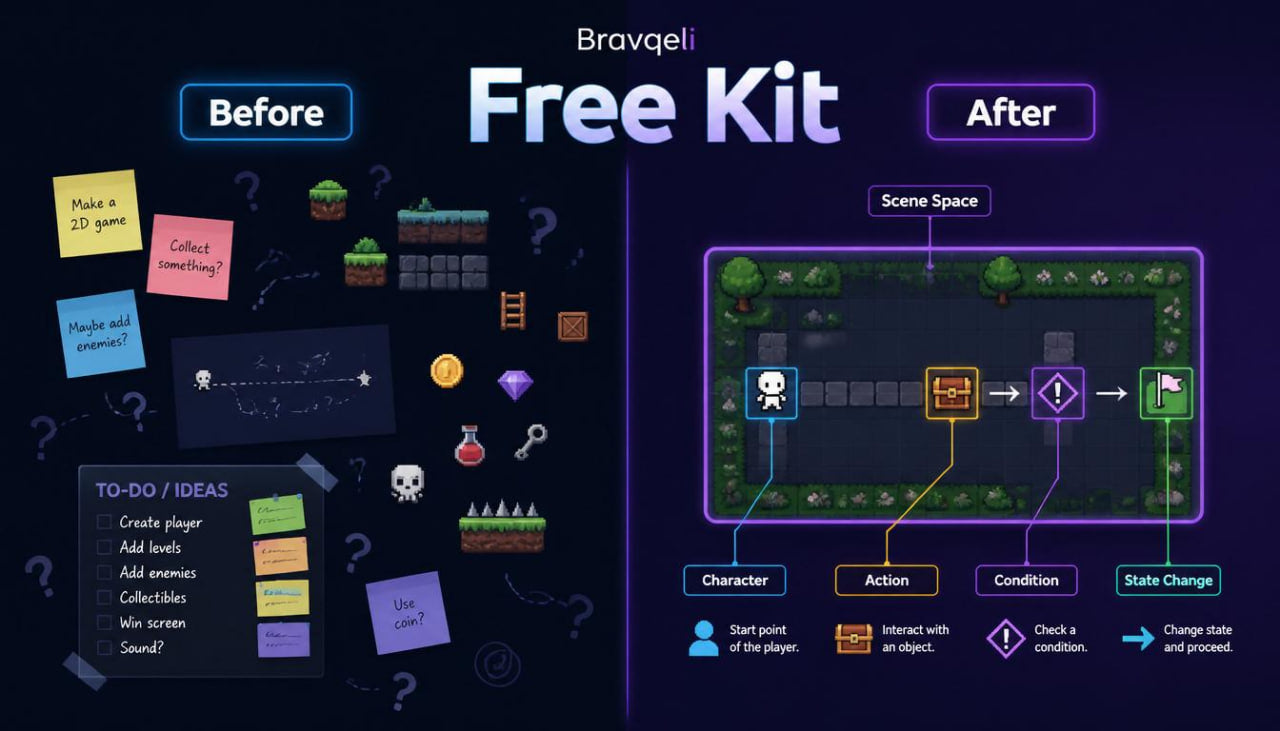
Many people are interested in game development, but they do not always know where to begin. At first, a game project can look like a group of complex parts: characters, rules, scenes, movement, goals, obstacles, and interaction. Because of that, a learner may delay study because the topic feels too broad and lacks a clear first entry point. Another challenge is that beginners often see the finished game, but not the small logical steps behind it. Without a structured introduction, it can be difficult to understand how one action connects to another and how separate rules form a game scene.
2. Solution
Free Kit was created as a calm first step into Bravqeli materials. It does not overload the learner with too many topics, but introduces basic ideas through short explanations and practical examples. In this tier, the learner sees how to think about a game not as something large and confusing, but as a sequence of small decisions. The materials help explain what a scene is, how a character works, what a simple action means, how a condition works, and what happens after an action inside a learning example. This format is suitable for a first look at the Bravqeli approach before moving to wider tiers.
3. What’s Inside
Inside Free Kit, learners receive short materials that introduce the basics of game thinking. The first block explains how to view a game as a system: there is a space, there are objects, there is a character, there are rules, and there are events that change the state of the scene. This helps show that even a small game idea is built from several understandable parts.
The second block focuses on the game scene. The learner is introduced to the scene as the place where action happens. The materials explain how a scene can have boundaries, goals, objects for interaction, and simple behavior rules. This block does not go into a heavy technical layer; instead, it helps form a basic view of how game space can be organized.
The third block looks at the character. It explains that a character in a learning example is not only a visual element, but also a part of the logic. A character can move, react, perform an action, change state, or interact with other objects. The learner sees how to describe character behavior in plain language before moving to more detailed materials.
The fourth block introduces the idea of a condition. In game development, a condition often defines what happens next: the character touches an object, the scene changes, a task is completed, an obstacle is passed, or an action stops. In Free Kit, this is explained through learning situations so the learner can see the connection between a rule and an outcome.
The fifth block includes small practice tasks. They are built so the learner can describe a game idea, divide it into parts, define the character, scene, action, and condition. The tasks do not require complex preparation, but they help the learner begin thinking in a structured way.
The tier also includes a short checklist for self-review. It helps the learner check whether the learning idea has a main action, a goal, a space, objects, and an interaction rule. A separate recap block collects the key thoughts in a compact form, so the learner can return to them during review.
Free Kit does not try to cover all of game development at once. Its purpose is to give a first contact with the topic, show the style of Bravqeli materials, and help the learner understand whether this study format feels suitable.
4. Who Is This For?
Free Kit is for people who are just beginning to explore game development and want to see the topic without extra noise. It can be useful for learners who are not yet ready to move into broader materials, but want to try the basic Bravqeli format.
This tier also works for someone who has a game idea but does not yet know how to divide it into parts. If a person can describe a character or a scene, but does not know how to connect them with rules, Free Kit helps show the first links.
The materials may also be helpful for those who want to review the Bravqeli explanation style. There is no overload of terms, large blocks, or confusing jumps. The focus is on the topic, example, small task, and short recap.
5. What You’ll Learn
- How to view a game as a system of parts.
- What a game scene means in a learning example.
- How to describe a character through action and behavior.
- How a condition affects the next event in a scene.
- How to divide a game idea into simple elements.
- How to create a short scene description.
- How to define objects for interaction.
- How to prepare basic task logic.
- How to use a checklist for review.
- How to understand the Bravqeli material style before choosing the next tier.
6. Refund Terms
Free Kit is a free introductory tier, so no payment is taken for it. Paid Bravqeli tiers include a 30-day refund option according to the store terms. If a buyer chooses one of the next tiers and sees that the material format does not fit, they can contact support within 30 days. This approach helps learners choose study materials without pressure and gives them time to review the format calmly.
Self-paced learning overview
- 🧾 Digital file available after purchase
- 🕒 Long-term availability
- 🔐 Secure checkout
- 🗓️ Content updated in 2026
What is included in Bravqeli learning materials?
What is included in Bravqeli learning materials?
Each tier includes structured game development materials: explanations, examples, practice tasks, short recaps, and review exercises. The amount of content depends on the tier, but the learning flow stays similar: each topic is divided into parts so the learner can study ideas, rules, and basic approaches gradually.
Do I need previous preparation?
Do I need previous preparation?
For the starting tiers, previous preparation is not required. The materials are built so the learner can begin with basic ideas: game scene, character, action, condition, interaction, task, and the structure of game logic.
What format are the materials in?
What format are the materials in?
The materials are provided in a digital format for self-paced study. They may include modules, written explanations, diagrams, task examples, practice exercises, checklists, and short review blocks.
Share