Bravqeli
Lattice Module
Lattice Module
Couldn't load pickup availability
1. Problem Statement
When the learner can already connect several scenes into a sequence, there is a need to organize the inner structure of each part with more care. A scene may include many objects, areas, conditions, transitions, and repeated actions, but without grid logic they can feel scattered. The learner may find it difficult to understand how element placement affects character action, route, choice, and reaction. Another question appears around repeating rules in different parts of the scene without making them feel random. Without this structure, a wider learning example can lose order, even when each separate scene already has a readable idea.
2. Solution
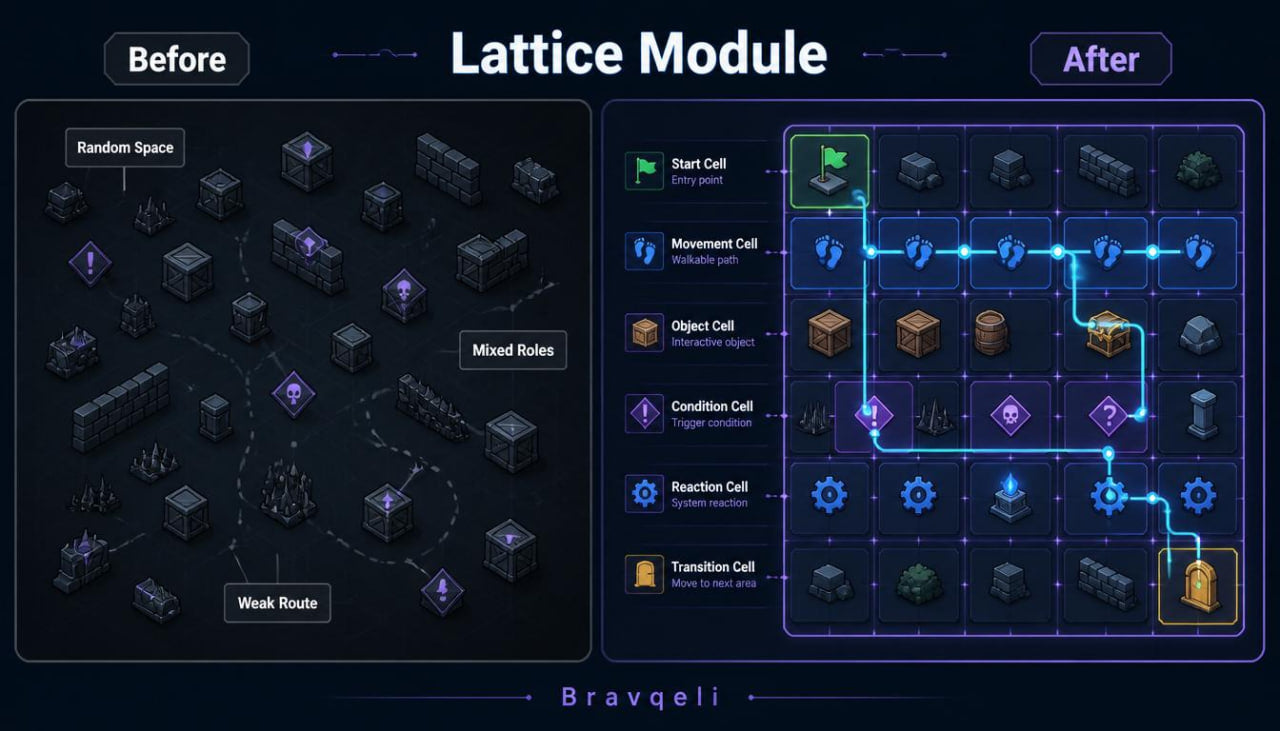
Lattice Module helps the learner view a scene as a grid where each area, object, and action has a place in the whole scheme. The materials show how repeated rules can support order in a scene and make interaction sequential. The learner works with examples where the space is divided into areas: start, movement, obstacle, interaction, change, and recap. This approach helps show not only events, but also how they are placed in relation to one another. Lattice Module fits the move from scene-to-scene routing into more careful planning of each scene’s inner structure.
3. What’s Inside
Lattice Module includes materials that explain a game scene through a grid of space, roles, and repetitions. If the previous tier helped connect several scenes, this tier focuses on inner order: where an element stands, what it does, how it affects the route, and why its place matters.
The first module focuses on grid thinking. The learner views a scene not as open space with random objects, but as a set of areas with connections between them. For example, one area can be the start, the second can be the movement area, the third can be the obstacle point, the fourth can be the interaction point, and the fifth can be the change area. This division helps show how the character moves through the learning example and why each part of the space has its role.
The second module explains action cells. Inside a learning scene, each part of the space can match a certain action: movement, waiting, condition check, object interaction, state change, or transition to the next part. The learner studies how to describe space through function, not only through appearance. This helps explain that object placement affects scene behavior.
The third module explores repeated structures. A scene can repeat one logic: the character enters an area, the scene checks a condition, the object reacts, and the state changes. In Lattice Module, these repetitions are presented as learning patterns that can be written into a table and used in several parts of the example. The learner sees that repetition does not have to make a scene plain when each repeated part has its own role.
The fourth module focuses on object placement. The materials explain how an object changes meaning depending on its place. The same object type can work as an obstacle, cue, route marker, or change point. The learner studies how to ask: why is this object here, what does it do in this area, how does the character interact with it, and what changes after this interaction.
The fifth module explains routes inside the grid. A character may move not only from left to right or from start to finish, but through several areas with different rules. The materials show how to create a route where each area adds one learning step: notice an object, move around an obstacle, perform an action, check a condition, move to a change. This route is easier to edit because the learner can see where overload or a gap appears.
The sixth module focuses on a condition grid. Conditions can be linked to a place, object, action, or state. For example, a condition may work only in a certain area, after interaction with a certain object, or after a state change. The learner studies how to write these conditions in tables: area, action, object, condition, reaction, new state. This makes the inner scene logic more practical for review.
The seventh module is about links between cells. In a scene, it is not enough to know what exists in each area; the learner also needs to understand how one area leads to another. The materials explain how to mark transitions, closed routes, open routes inside the example, return points, and state-change points. The learner sees how space can work as a learning map, not only as a background.
The eighth module explores grid editing. The learner sees examples where a scene has too many areas, repeated roles, extra objects, or unclear transitions. The materials show how to reduce the scheme, combine similar areas, remove extra details, or move an object to a place where its role becomes clearer. The focus here is on order, not on adding more parts.
The ninth block contains practice exercises. The learner creates a grid for a mini scene, defines areas, adds objects, writes conditions, marks the route, and describes changes after interaction. Other exercises suggest taking a scene from previous tiers and rebuilding it through a grid scheme. There are also tasks where the learner needs to find an empty area, an extra object, or a transition without a learning role.
The tenth block includes planning tables. The learner can write the scene name, area list, role of each area, objects, actions, conditions, reactions, transitions, and short recap. This table helps show whether the scene works as one system or whether some parts exist without connection.
A separate block is dedicated to review. It includes self-check questions: does each area have a role, is the route readable, do objects avoid repeated roles, are conditions linked to the right places, and can the grid be explained briefly. These questions help the learner return to the materials and improve personal learning examples.
4. Who Is This For?
Lattice Module is for learners who have already worked with separate scenes, routes, and conditions, but want to organize the inner structure of a scene with more care. If previous materials explained how to connect scenes, this tier shows how to divide one scene into areas and links.
It is useful for learners who want to plan levels, learning spaces, character routes, and object interaction in a cleaner way. The materials also fit learners who often add many details and want to see what has a role and what only makes the example heavier.
Lattice Module works well for learners who like tables, maps, schemes, and repeated structures. The focus here is order inside the scene: area, role, action, condition, reaction, and transition.
5. What You’ll Learn
- How to view a scene as a grid of areas and links.
- How to define the role of each space part.
- How to connect objects with specific actions.
- How to build a character route through several areas.
- How to write conditions through “area — action — object — reaction.”
- How to work with repeated structures in a scene.
- How to find extra areas, repeated roles, and weak transitions.
- How to create a grid planning table.
- How to connect space, action, and state change.
- How to prepare a base for more detailed learning materials in the following tiers.
6. 30-Day Return Terms
Lattice Module includes a 30-day period for payment return requests according to the Bravqeli store rules. If, after reviewing the materials, the buyer sees that the format, level, or structure of the tier does not fit their needs, they can write to the support team within 30 days. The request is reviewed according to the store terms and order details. This format allows the buyer to review the materials calmly and choose a further learning route without pressure.
Self-paced learning overview
- 🧾 Digital file available after purchase
- 🕒 Long-term availability
- 🔐 Secure checkout
- 🗓️ Content updated in 2026
What is included in Bravqeli learning materials?
What is included in Bravqeli learning materials?
Each tier includes structured game development materials: explanations, examples, practice tasks, short recaps, and review exercises. The amount of content depends on the tier, but the learning flow stays similar: each topic is divided into parts so the learner can study ideas, rules, and basic approaches gradually.
Do I need previous preparation?
Do I need previous preparation?
For the starting tiers, previous preparation is not required. The materials are built so the learner can begin with basic ideas: game scene, character, action, condition, interaction, task, and the structure of game logic.
What format are the materials in?
What format are the materials in?
The materials are provided in a digital format for self-paced study. They may include modules, written explanations, diagrams, task examples, practice exercises, checklists, and short review blocks.
Share