Bravqeli
Pulse Set
Pulse Set
Couldn't load pickup availability
1. Problem Statement
After studying the basic structure of a scene, a learner often meets a new question: how can the scene feel less static? A character can have an action, an object can have a role, and a condition can be written, but without rhythm the scene may still feel like a set of separate elements. In a learning game scene, it is important to understand not only “what exists,” but also “what happens after that.” If events are not connected, it becomes harder for the learner to see the logic of movement, reaction, and state change. That is why this stage needs materials that explain a scene as a chain of events, not as a still scheme.
2. Solution
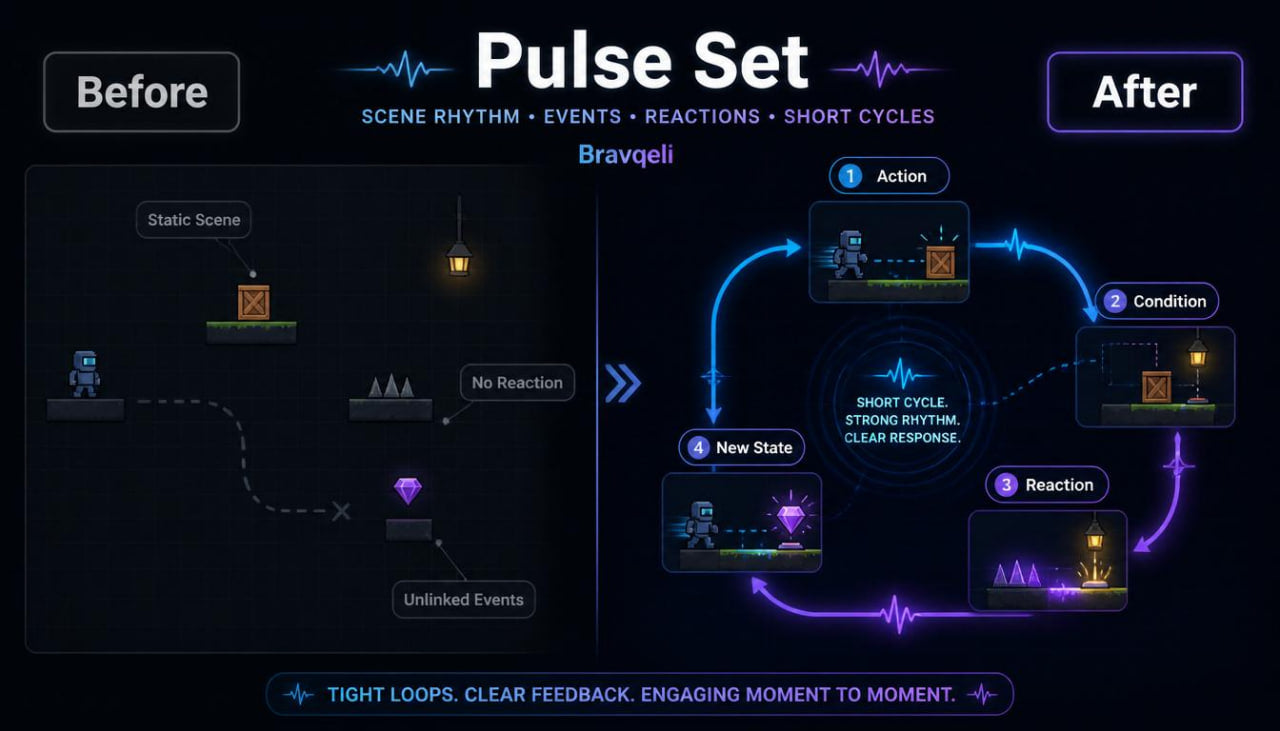
Pulse Set helps explain events and reactions inside a learning scene. The materials show how a character action can start a change, how an object can respond, and how a scene can move from one state to another. The learner works with short examples where each action has a cause, condition, and result inside the learning logic. This approach helps the learner see the rhythm of the scene: action start, condition check, change, repeat, or finish. Pulse Set fits learners who already understand the basic scene axis and want to move into events, states, and short game cycles.
3. What’s Inside
Pulse Set includes materials that explain a game scene through event movement. If the previous tier helped assemble the main axis of a scene, this tier adds its pulse: what starts, what changes, what repeats, and what closes the learning situation.
The first module focuses on the event. The learner studies how an event appears in a learning scene. It may be pressing an element, touching an object, entering an area, finishing a character action, or changing an object’s position. The materials explain that an event does not stand alone: it has a place, a participant, a condition, and a result inside the scene.
The second module explores scene reaction. After an event, something should change: an object may disappear, a path may open inside the example, a counter may change its value, the character may move to another state, or the scene may show a new task. The learner sees how a reaction makes the event readable. Without a reaction, an action can feel empty, so this block explains how to connect an action with a visible or logical change.
The third module is about states. In learning-focused game development, a state helps describe the current position of a scene, character, or object. For example, a door can be closed or open inside a learning example, a character can stand or move, and a task can be active or finished. The materials show how to write these states in plain language, making it easier to build interaction rules later.
The fourth module explains short cycles. In many game situations, an action repeats: the character moves, an object checks a condition, the scene updates its state, and the task is checked again. In Pulse Set, this is shown through small schemes where the learner sees how repetition can work without overload. The main idea of the block is to show that a cycle does not have to be complicated; in a learning example, it is enough to understand what repeats and when the repetition stops.
The fifth module focuses on transitions between events. The learner studies what happens after the first action, which condition leads to the second action, and how the scene reacts to a sequence. For example: the character takes an item, after that moves to another part of the scene, then interacts with a new object, and the scene changes the task. These examples help show the learning scene as a small story of actions.
The sixth block contains practice exercises. The learner receives tasks to describe an event, reaction, state, and short cycle for a mini scene. Separate exercises ask the learner to create a table: “event — condition — reaction — new state.” This helps show not only the idea, but also the order of how it works.
The seventh block is a set of planning schemes. They can be used to write the starting state of the scene, main event, reacting object, change after interaction, repeated action, and final recap. This format is useful for learners who want to think not only through images, but also through logical connections.
Pulse Set also includes a review block with short questions. The learner can check whether the scene has a starting event, whether the condition is written clearly, whether the reaction can be seen, whether there is a state change, and whether the sequence between actions stays organized. This block helps return to the material after exercises and see which parts of the scene need more detail.
4. Who Is This For?
Pulse Set is for learners who already understand the basic structure of a learning scene and want to study events more closely. If previous materials helped the learner see a character, action, object, and condition, this tier shows how those parts move through time.
This tier is useful for learners who want to create learning scenes with reactions: when a character action is not only described, but also leads to a change. It also fits people who want to better understand short cycles, repetition, and transitions between states.
Pulse Set does not require broad starting experience, but it works better after the introductory set and the basic tier about the game axis. The materials are suitable for learners who like schemes, tables, small tasks, and step-by-step scene analysis.
5. What You’ll Learn
- How to describe an event in a learning game scene.
- How to connect a character action with a scene reaction.
- How to write states for a character, object, or space.
- How to build a short action-and-check cycle.
- How to show a change after a completed condition.
- How to create an “event — condition — reaction — state” table.
- How to describe a transition from one action to another.
- How to avoid a chaotic set of events in a learning example.
- How to plan a mini scene with a repeated action.
- How to prepare a base for more detailed interactions in the following tiers.
6. 30-Day Return Terms
Pulse Set includes a 30-day period for payment return requests according to the Bravqeli store rules. If, after reviewing the materials, the buyer sees that the format, level, or structure of the tier does not fit their needs, they can write to the support team within 30 days. The request is reviewed according to the store terms and order details. This format gives the buyer time to review the materials calmly and choose a further learning route without pressure.
Self-paced learning overview
- 🧾 Digital file available after purchase
- 🕒 Long-term availability
- 🔐 Secure checkout
- 🗓️ Content updated in 2026
What is included in Bravqeli learning materials?
What is included in Bravqeli learning materials?
Each tier includes structured game development materials: explanations, examples, practice tasks, short recaps, and review exercises. The amount of content depends on the tier, but the learning flow stays similar: each topic is divided into parts so the learner can study ideas, rules, and basic approaches gradually.
Do I need previous preparation?
Do I need previous preparation?
For the starting tiers, previous preparation is not required. The materials are built so the learner can begin with basic ideas: game scene, character, action, condition, interaction, task, and the structure of game logic.
What format are the materials in?
What format are the materials in?
The materials are provided in a digital format for self-paced study. They may include modules, written explanations, diagrams, task examples, practice exercises, checklists, and short review blocks.
Share