Bravqeli
Vertex Guide
Vertex Guide
Couldn't load pickup availability
1. Problem Statement
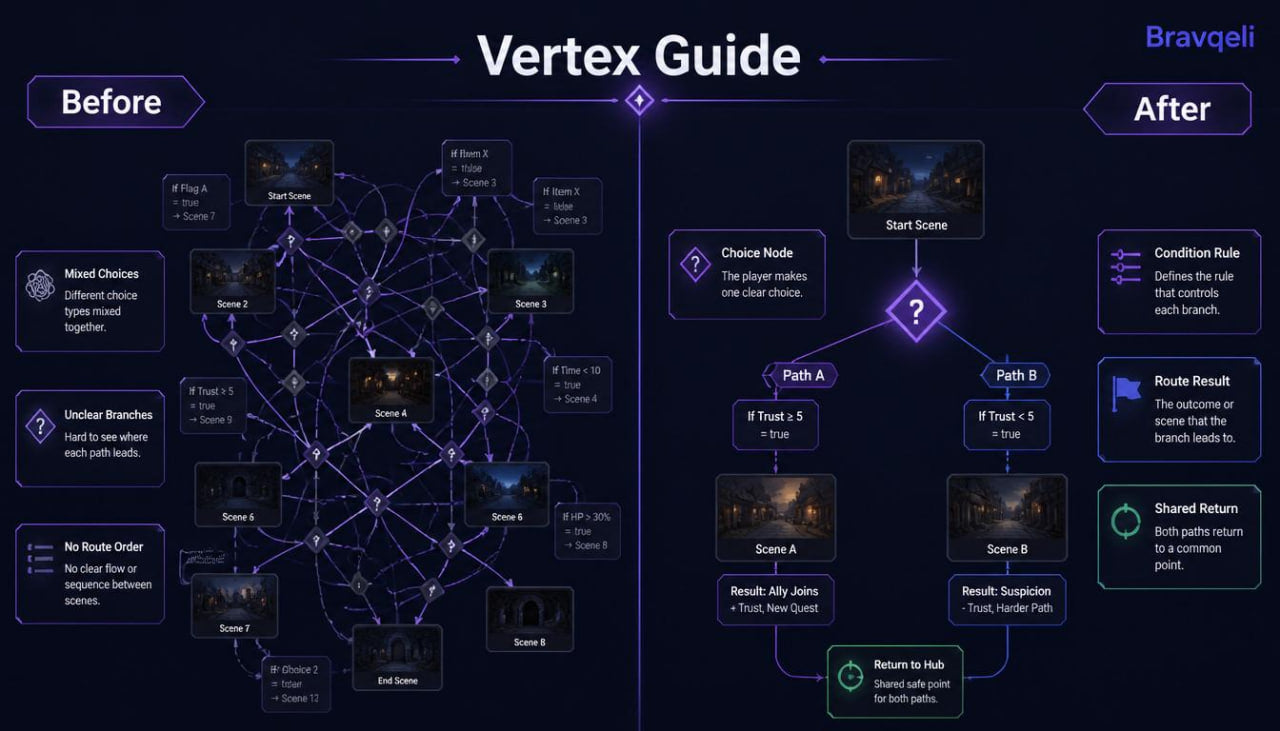
When a scene already has shape, boundaries, events, and reactions, the learner often meets a new question: how to build choice inside game logic. If each action leads to only one result, the learning example can feel too direct and may not show wider interaction variants. At the same time, too many variants can confuse the scene and make it harder to explain or review. The learner needs to understand where the choice point should be, which conditions affect the next route, and how to keep order between branches. Without this structure, a scene can have several interesting directions but still lack readable logic between them.
2. Solution
Vertex Guide helps the learner view a scene through nodes where action, condition, and result meet. The materials explain how to create simple branching: one choice leads to one state, another choice leads to another state, while the scene keeps a readable sequence. The learner works with examples where each branch has a reason, a boundary, and a recap. This approach helps not only add variants, but arrange them inside a learning scheme. Vertex Guide fits learners who already have a base in scenes, events, and framing, but want to work better with choice, conditions, and routes.
3. What’s Inside
Vertex Guide includes materials that explain how nodes work inside a learning game scene. If the previous tier helped build the frame of a scene, this tier adds choice routes to that frame. The learner sees how several actions can meet at one point, or how one action can lead to several following variants.
The first module focuses on the idea of a node. In a learning scene, this point appears where a decision should be made or a condition should be checked. For example, the character may approach two objects, choose a movement direction, activate one element, or perform an action that changes the next state of the scene. The materials explain that a node should be readable: the learner should see what is being checked and what each variant leads to.
The second module explores simple branching. It explains the scheme “if action A — then change A, if action B — then change B.” The learner works with short examples where one scene has two possible routes. For example, one object can change the character’s state, while another can change the state of the space. The materials show how to avoid overloading the example and keep only the variants that help explain the topic.
The third module focuses on choice conditions. Choice in a scene does not always mean a random decision. Often, it depends on what has already happened earlier: whether an item was collected, whether an action was completed, whether an object state changed, or whether the character reached the needed area. The learner studies how to write these conditions in plain language so the scene route stays sequential.
The fourth module explains choice outcomes. Each branch should lead to a certain change: a new scene state, another path, a new task inside the example, a hint appearing, or a mini scene ending. The materials help avoid empty choices. If a branch exists, it should have a learning role and explain a certain principle of game logic.
The fifth module focuses on the route map. The learner receives schemes where the starting point, choice node, variant A, variant B, condition for each variant, and final change can be written down. This map helps show whether every branch has logic, whether there are unnecessary repeats, and whether the main scene action stays visible.
The sixth module explores returning to the main route. Not every branch needs to lead the scene in a completely separate direction. Sometimes two different choices can return to a shared point, but with different states or details. The materials explain how to describe this return so the learning scene does not split into disconnected parts.
The seventh module focuses on incorrect or incomplete routes in learning examples. Here, the learner sees what a scene can look like when there is a choice but the outcome is unclear; when two branches repeat each other; when a condition is written too broadly; or when a branch does not lead to a change. These examples help the learner edit personal schemes with more care.
The eighth block contains practice tasks. The learner creates a mini scene with one node, two routes, and a short recap for each route. Another task asks the learner to take a linear scene and add one choice without overload. Separate exercises focus on condition checks: what should happen before the choice, what changes after the choice, and how the scene returns to the general logic.
The ninth block includes planning tables. They contain fields for scene name, main action, choice point, conditions, variants, outcomes, and recap. This form fits learners who want to see branching not only as text, but as a structured scheme.
Vertex Guide also includes a review block. It contains self-check questions: is it clear where the choice appears; does each branch have its own role; do the conditions avoid conflict; can the route be explained briefly; do extra variants distract from the main action. This block helps the learner return to the material after exercises and adjust the scene scheme.
4. Who Is This For?
Vertex Guide is for learners who can already describe a scene, action, event, condition, and change, but want to move into more flexible logic. If the previous tiers helped build a linear scene, this tier shows how to add choice without chaos.
It is useful for learners who have ideas with several routes: different doors, different objects, different scene reactions, or different ways to finish a task. The materials help not only add several variants, but explain why each one is present.
Vertex Guide also fits learners who like schemes, decision maps, and tables. A lot of attention is given to order: where the choice begins, which conditions shape it, what changes after each branch, and how the scene stays gathered.
5. What You’ll Learn
- How to define a node in a learning game scene.
- How to build simple branching with two routes.
- How to describe conditions for each choice variant.
- How to connect a choice with a scene outcome.
- How to create a route map for a mini scene.
- How to avoid extra or repeated branches.
- How to return different routes to shared logic.
- How to check whether each branch has a learning role.
- How to edit scenes with unclear choice points.
- How to prepare a base for more detailed interaction systems in the following tiers.
6. 30-Day Return Terms
Vertex Guide includes a 30-day period for payment return requests according to the Bravqeli store rules. If, after reviewing the materials, the buyer sees that the format, level, or structure of the tier does not fit their needs, they can write to the support team within 30 days. The request is reviewed according to the store terms and order details. This format allows the buyer to review the materials calmly and choose a further learning route without pressure.
Self-paced learning overview
- 🧾 Digital file available after purchase
- 🕒 Long-term availability
- 🔐 Secure checkout
- 🗓️ Content updated in 2026
What is included in Bravqeli learning materials?
What is included in Bravqeli learning materials?
Each tier includes structured game development materials: explanations, examples, practice tasks, short recaps, and review exercises. The amount of content depends on the tier, but the learning flow stays similar: each topic is divided into parts so the learner can study ideas, rules, and basic approaches gradually.
Do I need previous preparation?
Do I need previous preparation?
For the starting tiers, previous preparation is not required. The materials are built so the learner can begin with basic ideas: game scene, character, action, condition, interaction, task, and the structure of game logic.
What format are the materials in?
What format are the materials in?
The materials are provided in a digital format for self-paced study. They may include modules, written explanations, diagrams, task examples, practice exercises, checklists, and short review blocks.
Share